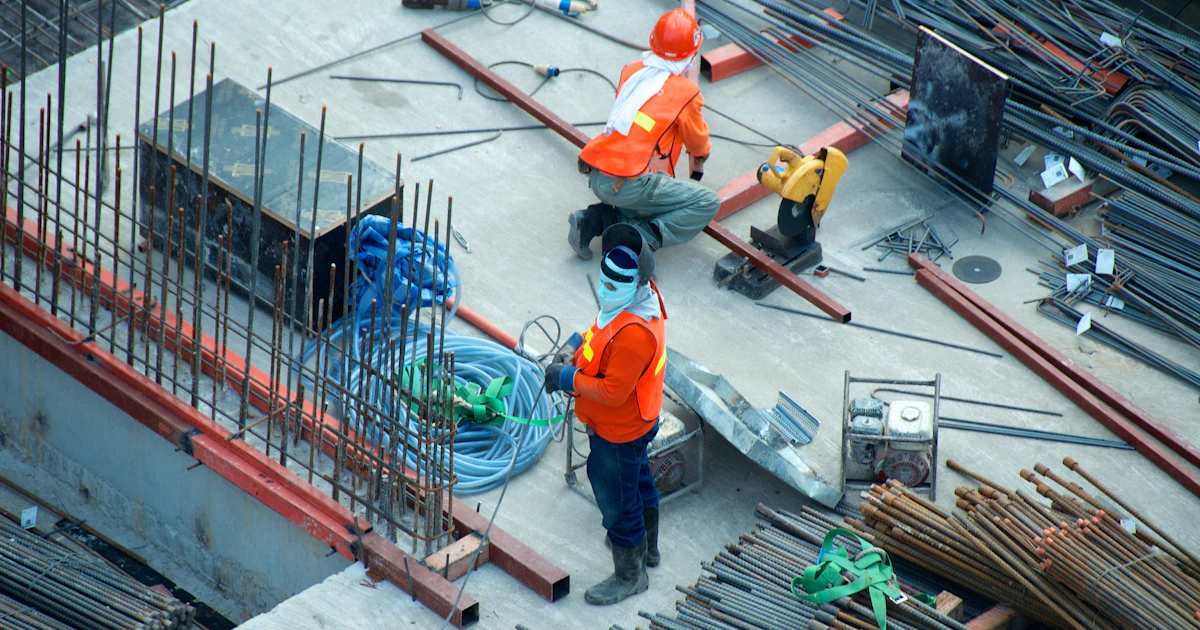
I didn't come to this problem from machine learning first. I came to it from structural engineering.
In structural engineering, stability isn't mysterious. A structure doesn't stand because it's big or heavy. It stands because load flows through it in very specific ways. If you understand those load paths, you can remove a surprising amount of material without compromising stability. If you don't understand them, removing a single critical element can bring the whole thing down.
If you've ever played Jenga, you already understand this at a gut level.
A fully assembled Jenga tower feels solid. But that doesn't mean every block matters. Most of them are redundant. The tower stands because a smaller subset of blocks quietly carries most of the load. Pull the wrong block and the tower collapses instantly. Pull the right ones and the tower barely reacts.
It turns out this is an almost perfect mental model for what's happening inside large AI models.
Dense models feel stable, until you look inside
Modern neural networks are massively over-parameterized. That redundancy is helpful during training, just like redundancy is helpful during construction. It absorbs uncertainty. It makes optimization easier. It gives the system room to settle.
But once training converges, that redundancy doesn't disappear. It remains embedded in the model as many equivalent internal pathways. These are different ways the same prompt can move through the network and arrive at roughly the same answer.
From the outside, the model looks stable. On the inside, it's more like an overbuilt Jenga tower.
You've probably noticed the symptom already. Ask the same model the same question multiple times and you often get slightly different answers. Not wildly different. Not wrong. Just... different.
That's not creativity. It's not alignment. And it's not just temperature.
It's structural variance.
Why pruning usually made things worse
For a long time, people tried to fix this by pruning models. Remove weights to make them smaller, faster, cheaper.
And just like Jenga, sometimes it worked. But most of the time, it didn't.
The reason is simple. Most pruning methods pulled blocks without understanding which ones were actually holding the tower up.
Magnitude pruning, random pruning, heuristic schedules. All of them treated parameters as if they were independent. In structural terms, that's demolition without load analysis. Sometimes you get lucky. More often, you remove something critical and the structure loses stability.
In models, that instability shows up as degraded quality, increased hallucinations, sensitivity to prompts, and generally less predictable behavior.
The problem was never that redundancy couldn't be removed.
The problem was that no one knew which redundancy mattered.
Stop removing blocks, start preserving load paths
In engineering, we don't ask, "How much material can we remove?"
We ask, "Which elements carry load, and how do we monitor the structure as we remove material?"
That question turned out to be the missing piece in model compression.
In neural networks, the true load paths aren't individual weights. They're high-information directions in the learned probability distribution, the probability manifold the model has actually learned.
If you preserve that manifold, the structure stays standing. If you don't, it collapses.
That's where Sparse Knowledge Distillation came from.
SparseKD is staged demolition, not guesswork
SparseKD treats a trained model the way an engineer treats an over-redundant structure scheduled for staged demolition.
Instead of guessing which parameters to remove, we treat the original model's output distribution as a global stability constraint. We remove redundancy gradually, not all at once. At every stage, we explicitly measure how far we've deviated from the original distribution.
In Jenga terms, we're not yanking blocks at random. We're removing them one by one, watching how the tower responds, and stopping the moment we see unacceptable deformation.
Mathematically, this does something very specific. It removes redundant degrees of freedom. It preserves the directions that actually carry semantic load. And it reduces variance in the model's behavior.
Why the model becomes more stable after you remove material
This part surprises people outside engineering, but it shouldn't.
A structure with excessive redundancy can hide instability. Once you remove non-critical load paths carefully, the remaining structure often becomes more stable, not less. Load flows become clearer. Oscillations dampen. Behavior becomes more predictable.
The same thing happens in neural networks.
After SparseKD, models tend to give more consistent answers to repeated prompts. They exhibit fewer low-confidence hallucinations. They respond less erratically to small changes in input.
The model still samples. It still generalizes. It just stops jittering in directions that never mattered in the first place.
The tower still stands, even after most of the blocks are gone, because the blocks that mattered were never touched.
We've run the same prompt through the same model hundreds of times, before and after SparseKD. The jitter shrinks. The outputs converge. It's not subtle.
This isn't really about compression
If you stopped here, you'd probably call this compression. Most people do.
Yes, SparseKD makes models smaller. And yes, smaller models tend to run faster, use less memory, and cost less to deploy.
But that was never the point.
The point was variance reduction.
Compression is a consequence, not the objective. What matters is understanding why a model stands at all. Once you understand the load paths, you can remove redundancy without destabilizing the system. Variance drops, behavior tightens, and consistency emerges naturally.
When redundancy is removed correctly, stability stops being fragile. Consistency stops being something you chase with heuristics and patches. It becomes a structural property of the model itself.
Why this matters for every AI model
This isn't just a safety-critical problem. It's a universal one.
Every large probabilistic model today exhibits variance caused by redundant internal pathways. Every one of them wiggles slightly when asked the same question twice. That wiggle isn't personality. It's structure.
SparseKD addresses that at the root.
Redundancy creates variance. Variance creates instability. Reducing redundancy, correctly, restores stability.
That's not a heuristic.
That's engineering.
Closing thought
Jenga is fun because the tower looks stable right up until the moment it isn't.
Large AI models feel similar. They're powerful, capable, and impressive, yet they sometimes behave in ways that feel slightly unstable or inconsistent. That instability isn't mysterious. It's not a personality trait of the model. It's the natural result of excessive redundancy hiding where the real load paths are.
Sparse Knowledge Distillation exists because we stopped treating models like black boxes and started treating them like engineered structures. When you understand why a system stands, you can remove what's unnecessary without fear.
The goal isn't to make the tower smaller.
The goal is to make it honest about how it carries load.
That's the work we're doing at SparseTech. And we're just getting started.
For the full mathematical framework, read the paper: Sparse Knowledge Distillation